All Categories
Featured
How Does LendingTree Get Paid? LendingTree is compensated by companies whose listings appear on this website. This payment may affect how and where listings appear (such as the order or which listings are included). This website does not include all companies or products offered. We are devoted to providing accurate content that helps you make informed money choices.
Read our editorial guidelines here. Americans have a record quantity of credit card debt $1.252 trillion, to be precise. This charge card financial obligation statistics page tracks Americans' credit card utilize each month. We update this page regularly, taking a look at how much financial obligation consumers hold, how typically they bring balances from month to month, how often they pay their credit card expenses late and other crucial patterns.

While credit card financial obligation tends to increase year over year, it typically falls from Q4 of one year to Q1 of the next. Even with this quarter's reduction, credit card balances have actually increased by $482 billion since Q1 2021, when credit card financial obligation bottomed out at $770 billion during the pandemic.
Americans' credit card debt is $325 billion greater than the pre-pandemic record embeded in Q4 2019, when balances stood at $927 billion. (That's a 35% boost.) Credit card balances have actually traditionally rebounded after first-quarter declines, though future borrowing patterns will depend on factors consisting of rates of interest, inflation and wider economic conditions.
Finding 2026 Financial Hardship Help
Credit card debt increased progressively up until the financial crisis, then declined from $866 billion in Q4 2008 to $660 billion in Q1 2013 before resuming its upward trajectory. Then, when the pandemic took hold in 2020, charge card balances plunged again from $927 billion in Q4 2019 to $770 billion in Q1 2021.
Credit cardholders in Connecticut have the highest typical credit card financial obligation of any state, according to LendingTree data, while those in Mississippi have the most affordable. Source: LendingTree analysis of the anonymized credit reports of more than 400,000 LendingTree users in the third quarter of 2025 and more than 410,000 in Q3 2024.
Joint accounts were divided in half to show shared duty in between the account holders. LendingTree experts reviewed anonymized credit report data from Q3 2025 for more than 400,000 LendingTree users to calculate these averages and develop a list of states with the most financial obligation. The analysis was likewise compared to Q3 2024 data from more than 410,000 reports.
Will Debt Management Help Your Credit Future?Eleven states had typical balances of at least $9,000. Connecticut leads at $9,778, ahead of New Jersey ($ 9,748) and Maryland ($ 9,630). The 6 states with the least expensive balances remain in the South. Mississippi's balance is $4,887, lower than Arkansas ($ 5,259) and West Virginia ($ 5,336). Washington has the fastest-growing card debt in the duration analyzed.
Detailed Analysis of Debt Relief Trends
Three other states saw double-digit increases, including South Dakota (up 11.7%), Nebraska (up 11.3%) and Wisconsin (up 10.2%). Meanwhile, New Mexico saw the biggest year-over-year decrease in debt, with its homeowners' debt falling 10.3% from $6,543 to $5,871. In all, seven states saw credit card balances reduce in the previous year.
Fewer than half of adult credit cardholders (45%) brought a balance on a charge card for at least one month in the past year, according to a May 2026 Federal Reserve research study utilizing 2025 information. Paying a credit card balance in complete each month is the most reliable way to avoid interest charges and keep financial obligation from accumulating.
Will Debt Management Help Your Credit Future?For cards accumulating interest, the average in Q2 2026 was 22.15%. For brand-new credit card provides, the average is 23.79%.
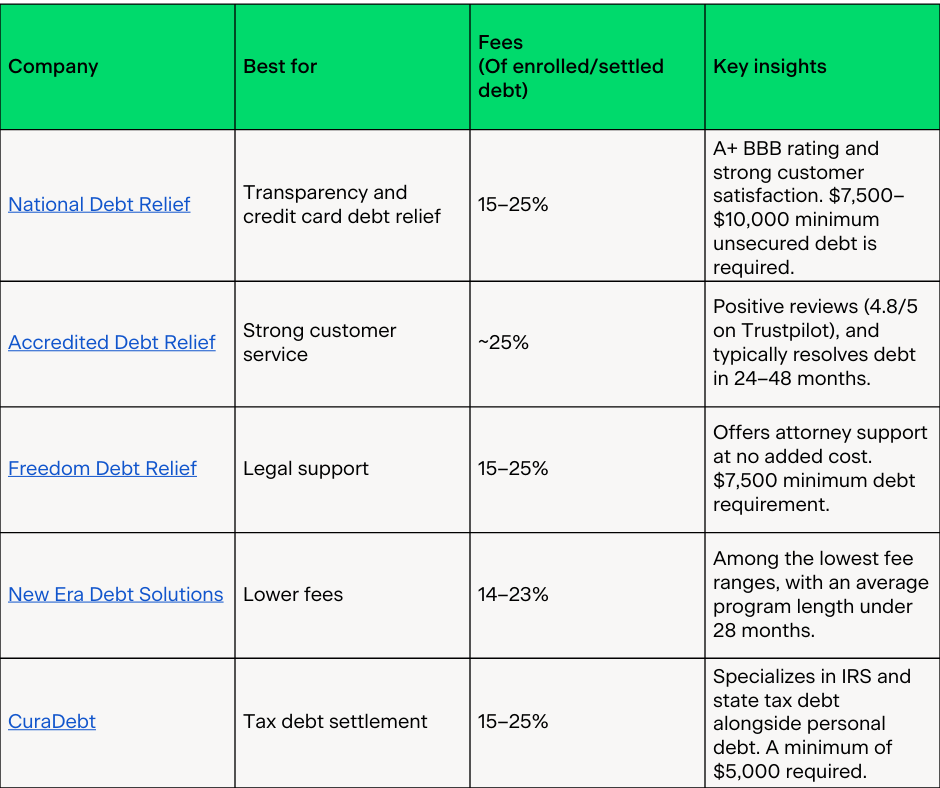
Consumers opening a new charge card account might deal with greater rates than the averages for existing accounts. The latest LendingTree data on charge card APRs shows that the typical APR with a brand-new credit card deal is 23.79%, with the average card providing an APR range of 20.18% to 27.41%.
When the Fed raises or reduces rates, the majority of credit card APRs in the U.S.No matter when the Fed acts next, any movement is likely to be small, meaning credit card APRs would likely remain elevated by historical standards. Simply 2.92% of Americans' impressive credit card balances were at least 30 days overdue in the first quarter of 2026., the 30-day delinquency rate the share of exceptional credit card balances that were at least 30 days past due dipped to 2.92% in the first quarter of 2026, the seventh straight quarterly reduction.

Latest Posts
Comprehensive Debt Relief Reviews to Watch
Finding Financial Hardship Help in 2026
Objective Evaluations of Top Management Strategies